Destroying Iran’s Infrastructure Is a Hard Task, and There Are No Effective Means to Do It at Scale
To obliterate both the electrical and oil sectors, multiple waves of missiles and guided bombs would be required against each of these targets. We are talking about 6,000 to 10,000 projectiles.

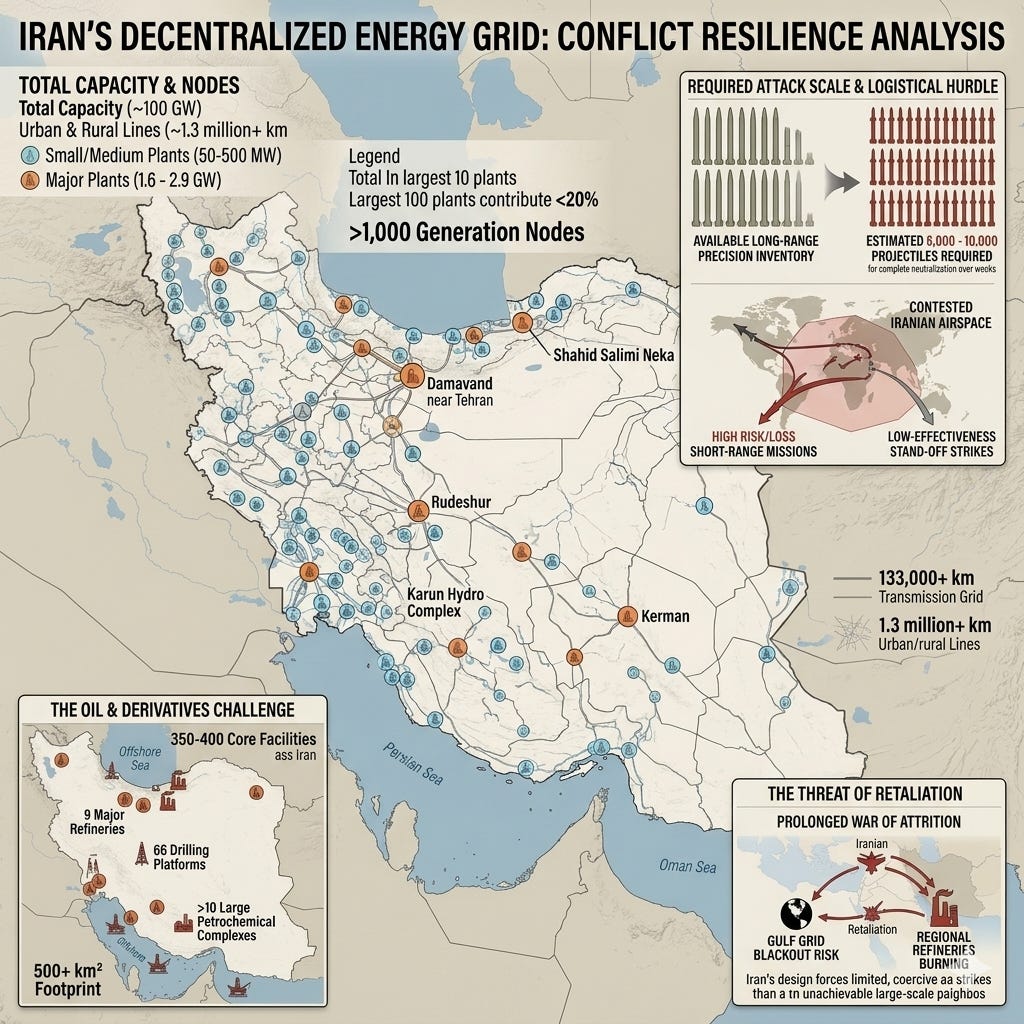
In many countries, striking the power grid would create immediate chaos and constitute a terrifying threat. In Iran, however, the task is far more difficult.
The Iranian electric grid is one of the most decentralized in the world, with around 130 to 150 large power plants, primarily gas-fired thermal plants. No single facility dominates large portions of the country’s electricity generation. The largest plant, Damavand near Tehran, has a capacity of approximately 2,868 MW, only about 2.9% of total installed capacity.
Other major plants, such as Shahid Salimi Neka, Rudeshur, Kerman, and several hydroelectric facilities on the Karun River (including Karun-3), range from 1.6 to 2.2 GW each. Even combined, the five to ten largest plants account for less than 15-20% of total capacity. The rest is spread across dozens of smaller and medium-sized facilities.
When these medium-sized plants and small distributed power stations are added, the total number of generation points connected to the national grid exceeds 1,000. This forms a highly decentralized system explicitly designed to withstand high-intensity conflict.
To effectively paralyze Iran’s electricity supply, an adversary would also need to target the transmission and distribution network, which stretches over 133,000 kilometers, and exceeds 1.3 million kilometers when rural and urban lines are included.
Adding Iran’s oil and derivatives infrastructure makes the challenge even greater. This sector includes approximately 350 to 400 main facilities distributed among processing, storage, and export units. These comprise 9 main refineries, 66 drilling platforms, and more than 10 large complexes, occupying a combined area of over 500 km² spread across Iranian territory.
To obliterate both the electrical and oil sectors, multiple waves of missiles and guided bombs would be required against each of these targets. We are talking about 6,000 to 10,000 projectiles, attacks that would take weeks. The ammunition simply does not exist in the American arsenal available today, except for short-range bombs. Those short-range bombs would force aviation deeper into Iranian airspace, significantly increasing aircraft losses.
Keep reading with a 7-day free trial
Subscribe to Global21 to keep reading this post and get 7 days of free access to the full post archives.